Xijia (Ray) Che
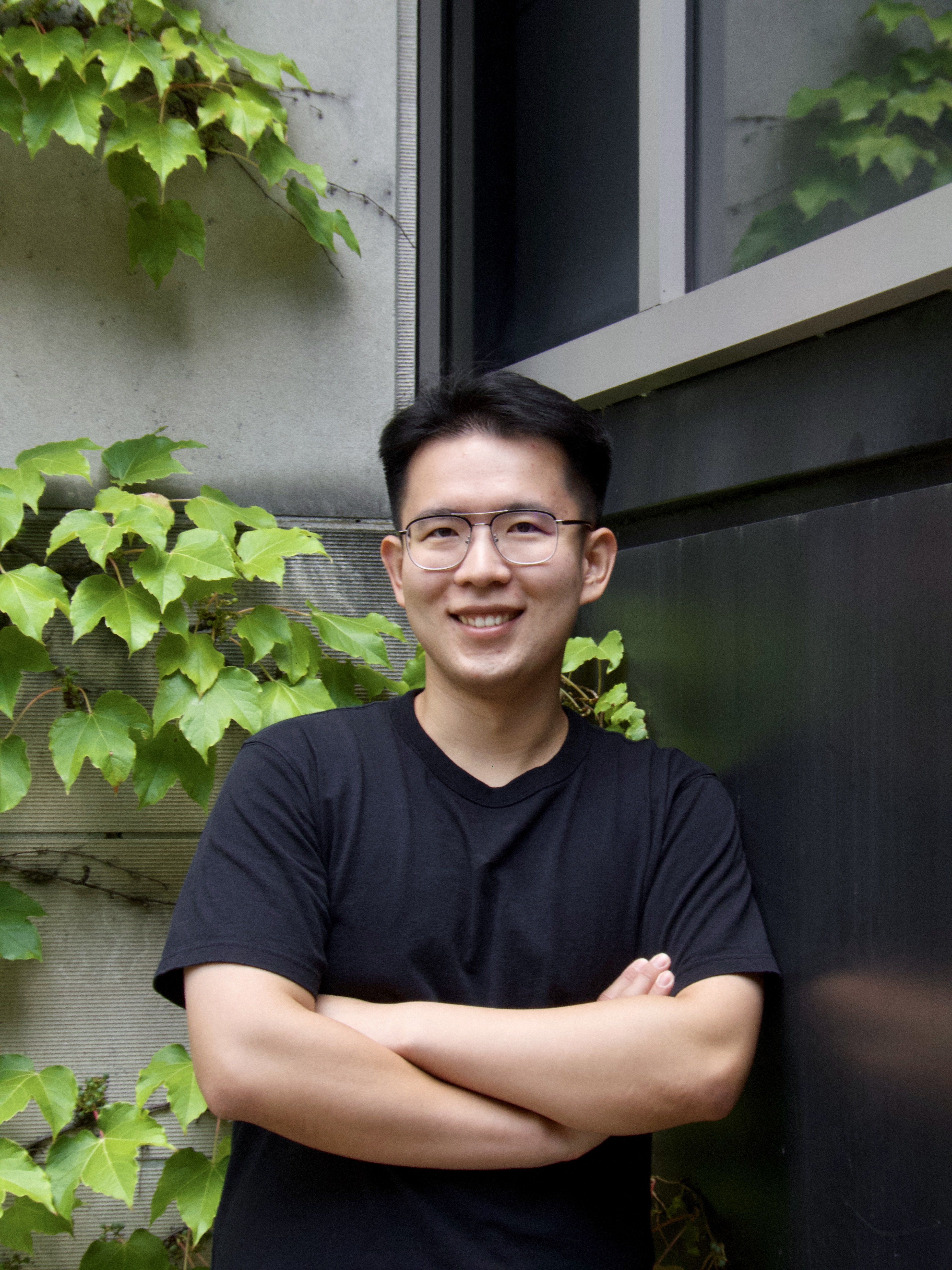
I am a second-year CS Ph.D. student at the University of Illinois Urbana-Champaign (UIUC), advised by Prof. Xiaojing Liao. My research focuses on AI security and safety. Specifically, I am interested in
- Multi-agent system safety: red-teaming, monitoring, and securing multi-agent systems against malicious attacks and emergent joint misbehaviors.
- AI infrastructure security: protecting large-scale computing and data centers from AI-driven intrusion.
Previously, I received my B.E. and M.S. degrees from Tsinghua University, advised by Prof. Qi Li.
I am looking for a research internship for summer 2027. Please reach out if you know of any opportunities!
Email / Google Scholar / GitHub / LinkedIn / X / Blog / Photos
News
- Nov 2026 – Passed my Ph.D. qualifying exam at UIUC.
- Aug 2026 – Attended BlueDot Context Week at Berkeley.
- Jun 2026 – Joined the Second Look AI Safety Program.
- Sep 2025 – Awarded the Wing Kai Cheng Fellowship at UIUC.
- Aug 2025 – Started my Ph.D. studies in Computer Science at UIUC.
Research
Haoyu Li, Xijia Che, Yanhao Wang, Xiaojing Liao, Luyi Xing
arXiv preprint, 2026
paper
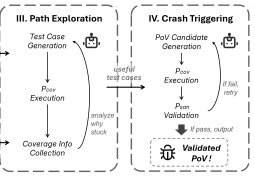
We present DrillAgent, an LLM agent that generates proofs-of-vulnerability via a hypothesize–verify–refine loop grounded in concrete execution states, solving up to 52.8% more CVEs on SEC-bench than prior agents.
Xijia Che, Yi He, Xuewei Feng, Kun Sun, Ke Xu, Qi Li
ACM CCS, 2024
paper / code / slides
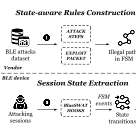
BlueSWAT detects BLE session-based attacks by modeling them as malicious paths in a finite state machine, and deploys rules as reboot-free eBPF patches, mitigating 76.1% of attacks with 0.073% memory overhead.
Yi He, Roland Guo, Yunlong Xing, Xijia Che, Kun Sun, Zhuotao Liu, Ke Xu, Qi Li
USENIX Security, 2023
paper / code / slides / video
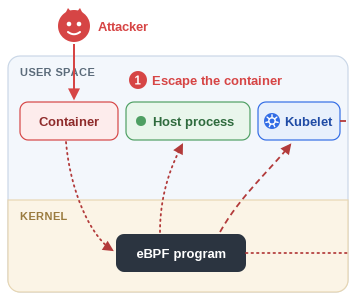
We show that eBPF tracing breaks container isolation, enabling data theft, DoS, and container escape. We compromised five online shell services, Google Cloud Shell, and Kubernetes services of three cloud vendors.
Xijia Che, Zephaniah Roe
Blog post, Nov 2026
blog / LessWrong
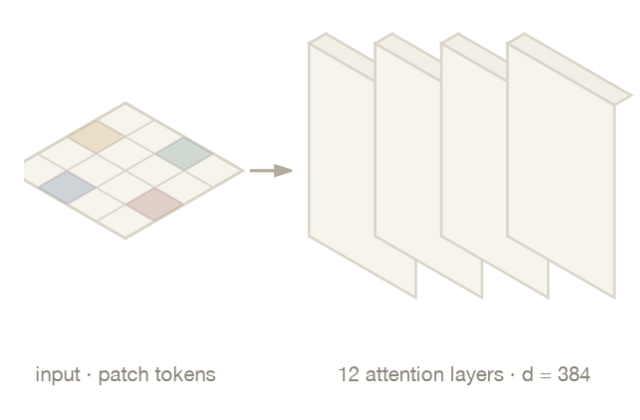
We replicate vision transformer experiments linking superposition to adversarial attacks across four image classification datasets: greater superposition strengthens the relationship between attacks and class-vector geometry.

Xijia Che, Zephaniah Roe
Blog post, Jul 2026
blog / LessWrong
We replicate three core claims of Stevinson et al. in toy classifiers: PGD attacks match theoretical optima, robustness drops as superposition grows, and attacks transfer because feature geometry converges across runs.
Talks
- Confirming Claims of Superposition and Adversarial Examples in Toy Models
Security and Privacy Seminar, UIUC, Aug 2026 / slides - BLE State-Aware Defense on IoT and Embedded Devices
Graduates Forum, Institute for Network Sciences and Cyberspace, Tsinghua University, Oct 2024
Experience
- AI Safety Researcher — BlueDot Context Week, Lighthaven, 2026
- AI Safety Research Fellow — Second Look Research, University of Chicago, 2026
- Visiting Student — Yale University, 2019
Service
- Reviewer: IEEE TDSC, IEEE TIFS
- External Reviewer: NDSS 2025, USENIX Security 2024
- Artifact Evaluation Committee: IEEE S&P 2027, USENIX Security 2026, ACSAC 2022
Education
- University of Illinois Urbana-Champaign — Ph.D. in Computer Science, 2025 – present
- Tsinghua University — M.S. in Cyberspace Security, 2022 – 2025
- Tsinghua University — B.E. in Electronic Engineering, 2018 – 2022
Awards
- Wing Kai Cheng Fellowship, University of Illinois Urbana-Champaign, 2025
- Outstanding Graduate, Institute for Network Sciences and Cyberspace, Tsinghua University, 2025
- National Scholarship, Ministry of Education of China, 2024
- Deng Feng Scholarship, Tsinghua University, 2024
- Academic Progress Scholarship, Tsinghua University, 2020
Misc
Volunteer middle school teacher:
- “Book Spine,” Xinjiang, 2024
- “We The Painter,” Tibet, 2022
- “Self Discovery,” Shanxi, 2021
- “Dream School,” Fujian, 2019
November 2026
Website template from Jon Barron.